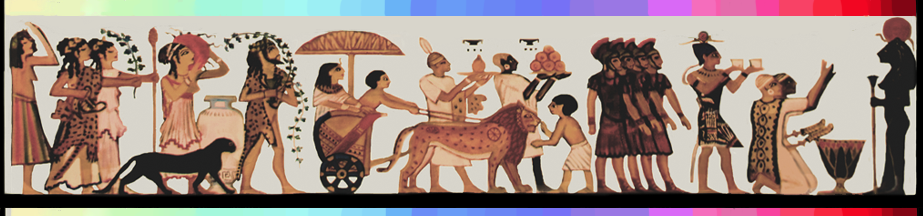
View MAAT Tarot MOON Signs here
Real Sky Astrology!?
Real Sky Astrology is the brain child and intellectual property of tarot artist and author Julie Cuccia-Watts. At first glance you may think you're looking at an insurmountable rocky cliff face with a difficult climb but if you take that challenge you will find yourself on a new level overlooking an amazing and liberating new vista. Like the Giza plateau itself you will suddenly reach a higher view and see what seems to be forever.
Real Sky Astrology begins with our understanding of historical bias and even the way we view the world as a product of Western Culture. It may even begin with Alexander the Great whose descendants respected knowledge and beauty. It took a trip to Egypt for me to see that the Hellenistic era pharaohs were dedicated to rebuilding Egypt to its former glory. The Denderah temple is a monument to that ancient legacy. The temple was reconstructed from ancient scrolls and is an unbelievable piece of architectural engineering.
The earliest religious practices of ancient Egypt's nature religion included advanced mathematics and star worship. The temple alignments to rising stars were a testament to their devotion to sky watching. When the experts tell you that the Babylonians invented astrology I can tell you that the Babylonians were the last of the foreign invaders who were busy looting ancient Egypt and destroying her temples. That it was Alexander who pushed them all the way back to the Tigris and Euphrates. These are the little things you learn when you go to Egypt and actually talk to their experts. You start to see the origins of everything in your life can be traced back to ancient Egypt including the Rx in the local pharmacy.
Modern Western Astrology the mainstream pop culture stuff from the newspaper we all recognize has its source from the translated work of Claudius Ptolemy. What we never knew was that Claudius Ptolemy was a Roman citizen living in Alexandria and he is credited with the discovery of precession. However Ptolemy’s “discovery” of precession is on the level of Columbus discovering The New World. Ironically Ptolemy’s writings on geography and his inaccurate translation of the Egyptian calculations of the globe may have given Columbus a bit of a scare before he landed in The New World. The scrolls of Eraosthenes (300BC) had been Ptolemy’s source. Eraosthenes was able to calculate the size of the Earth by measuring the shadows in Upper and Lower Egypt at the same time and comparing the difference in shadow size he was able to calculate the size of the earth.
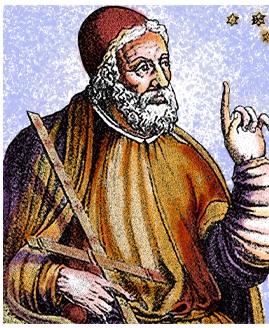 Claudius Ptolemy lived in Alexandria during the Roman occupation from 90 to 170 CE approximately. He was a librarian at the Library of Alexandria from 127 to 150 giving him access to whatever precious ancient knowledge that may have survived the library’s burning in the previous era. Ptolemy famous for three great scholarly works: the Almagest– a book of astronomy and geometry, the Tetrabiblos– a book of astrology, and a book of Geographythe ancient Egyptian world had knowledge of a spherical world.Sometime before his death he calculated when the Age of Pisces would begin. 221AD was the year Pisces would appear at the horizon at the equinox replacingthe constellation Aries that had risen there for the previous 2160 years. This perfect alignment would last exactly 72 years before ever so slowly this sky would shift one degree. And for every 72 years that went by the sky would move out of sync with Ptolemy's projected sky. Until astronomy and astrology were hopelessly split during the Renaissance when science and mysticism went their separate ways. The Mystics held fast to the 221AD sky in their magical books and the astronomers divorced themselves from magical thinking observing the world around them. Even today it would seem as if science and spirituality will never find common ground again.
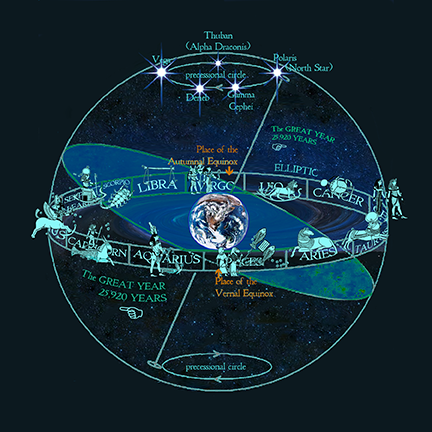
In astronomy precession refers to the gradual shift in the orientation of Earth's axis of rotation, which, like a wobbling top, traces out a pair of cones joined at their apices in a ~25,920 year cycle (called MAGNUS ANNUS* or The Great Year, also known as the Platonic Year in modern astrology). Precession, then, is the slow, wobbling conical motion of the Earth’s axis around the axis of the ecliptic. It is this tilt of the earth’s axis that causes seasons. Precession is caused by the wobbling, axis of rotation think of this big juicy planet with it’s hot iron core, big heaving oceans that rise and fall with the moon’s orbit.
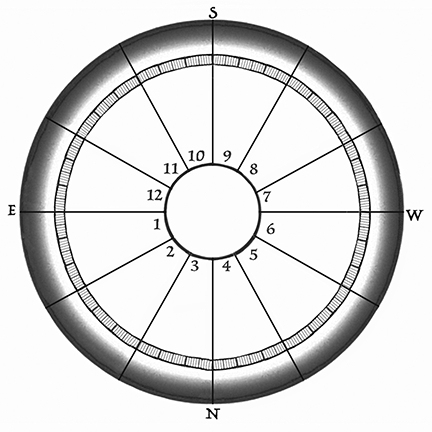
The big clue to Egypt’s connection to astrology was the framing of the horoscope itself. The non-European compass points of the horoscope chart are positioned in Egypt’s worldview. Lower Egypt is north and Upper Egypt is south the rising sign in the east is to the left and the descendent west is on the right. The 12 months of the Egyptian calendar were divided into three 10-day weeks exactly like the 10° decants twelve 30° houses of a horoscope chart. There was too much forensic evidence here to just pass off.
As I began to drop my preconceived ideas about astrology and astrological meanings and let my mind free associate with the mythos of ancient Egypt. I began to see the gods of Egypt coming alive in the symbols of astrology. This was without a doubt an Egyptian framework. I looked at the signs and saw the male/female assignments associated with each sign oddly out of place and that the signs themselves were clearly split down the middle by the Milky Way into masculine and feminine symbols. Now I was heading into uncharted territory but that is what an artist does, experiment and play around with how things fit. Considering how much our parent figures have been lied to, this is par for the course. I began to see this celestial line up based on the ceiling of Denderah paired with the earliest forms of Greek astrology that sources explained as one long woman. All I could think of was the star spangled goddess of the sky Nut (nuit, night, Neith) and the Wadjet an ancient snake goddess whom all the goddesses of Egypt seem to be a facet of.
The Milky Way divided the sky like the Nile divided the land. And this is the dividing line between the masculine signs and the female signs. The Circle without beginning and without ending has no first sign it is not locked into place. Though the ordering of the signs remains constant.
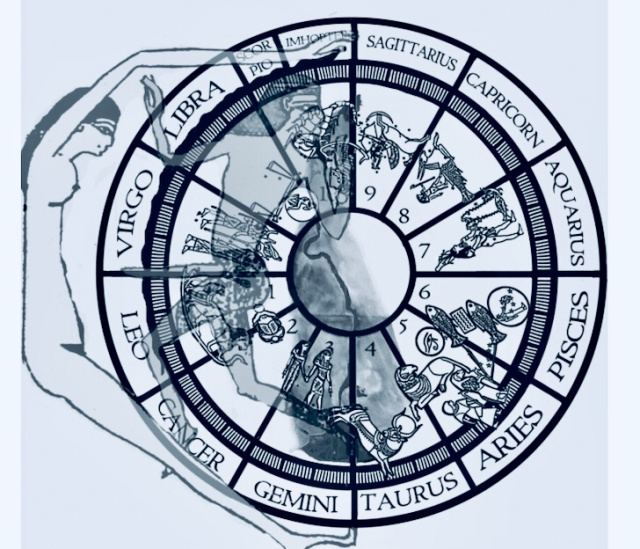
The Zodiac Signs from the ceiling of Dendera
with updates from more recent study for 2026. After working with the Zodiac symbolism of the Dendera ceiling the political bias of the GrecoRoman Era began to become apparent. Since deep diving into the Ages while working on The Real Sky Astrology ORACLE of the Great Year some unshakable insights have inspired me. The constellations observed at the horizon at Equinox may reveal a human history embodied in Star lore the symbols of the zodiac and the ancient Egyptian deities point to a distant memory from before the written words of patriarchal cultures.
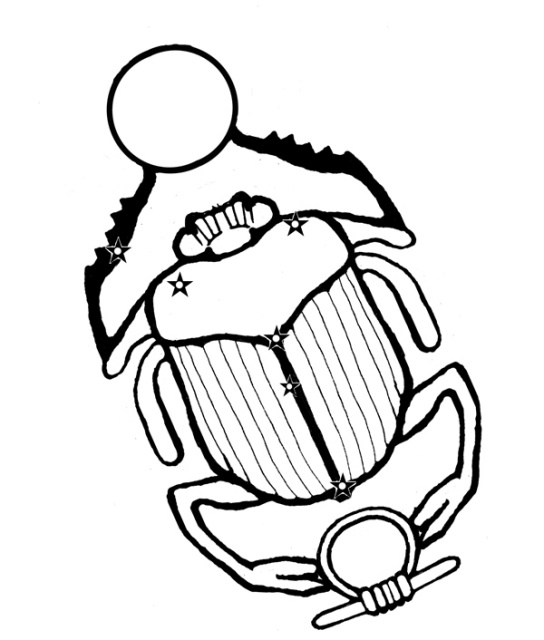
Cancer-Khepra/ The Scarab
androgynous sign
Human Culture Rising
The god Khepra, Khepera, Kheper, Khepri, Chepriis the scarab beetle pushing the sun across the sky in ancient Egyptian mythos, taking the form of a scarab, as well as a beetle-headed man. Khepri is the self-born god of the sunrise, ‘He who is Coming into Being’, Khepri rises out of the earth each morning like a scarab beetle rising from the ball of dung and he is also the one who pushes the ball of the sun across the sky. The Scarab is the ancient Egyptian equivalent of the butterfly symbol, but this metamorphosis has a twist. It not only transforms, it transforms from excrement. It is another metaphor of emerging from the primeval mound. The power of the Scarab beetle goes beyond the symbolism of the Crab adapted by western astrology, beyond the hard shell of protection. This beetle in amulet form was placed on the only remaining organ left in the body after death. The scarab beetle was placed on the heart to keep the heart from betraying itself. The heart was thought to be the true seat of consciousness as some experts on energy fields of the body will tell you. The heart can read the room five seconds before the head can.
Reproductions of scarabs in faience created with quartz, calcium carbonate, soda ash and malachite (copper carbonate) were worn in rings, bracelets, and necklaces. The beautiful symbolism of the life cycle of this mighty little composter is appreciated by the ancient Egyptians. The egg of the scarab beetle develops through stages and at one point it looks like a tiny sarcophagus inside its perfectly round dung ball which the parent continues to roll. At the end of its gestation, it emerges out of dung fully grown, beautiful, shining, and whole as if it were a spontaneous creation. Knowing the importance of decomposition, the ancient Egyptians placed the scarab symbol on the ecliptic to ensure its return again and again.
Khepri is one of the multifaceted forms of the sun god Ra who in his earliest form was known as Atum-Re. The ancient Egyptian language is full of wordplay, metaphor, and humor. None of these names were taken literally but were used to illustrate a point and the layers of symbolism were to create understanding. The magical utterances were an attempt at describing the power of the natural world around and inside of them.
To the western mind the idea of Re as the personification of the Sun or day would miss the rest the nuisance in the journey of the Sun for ancient Egypt’s. Re also descended into the portal of the west and took a journey to the Far World or Duat where he would encounter perils and overcome tests and trials and each of these stages would have a name. Here we see the importance of Khepri as the moment of triumph as he rises renewed after his long journey through the night. This energy of renewal is given to the placement of the Scarab symbolism wherever it lands in your chart.
The Timeline and Human Historical Context for the Age of Khepra-The Scarab
The Ages begin and end with the subtle nuance of shades of paint or rainbows of light as they blend from one color to the next. When did the Age of Khepra-the Scarab begin to glimmer into reality? According to my calculations around 8,637 BCE the people of this era were rising out of the era of cataclysm, they were a few million souls who were descendants of the survivors of the Ice Age and the Great Flood. These people were intentionally planting, still foraging and hunting, but had now begun to raise animals and keep them. Settlements were beginning to become more permanent, they had fire, stone tools, and a healthier gut biome that people in our modern world. These people were migrating along ancient coasts hunting in the landmasses above sea level in the area that is now occupied by the North Sea, the Sahara is green and lush with large, inhabited lakes, herds of animals and people. The domestication of animals and practices of cultivating grains expands. Cats, pigs, and cattle are added to the list of animals living with people. Populations rise from about a million people globally to around five million people. The work of farming and growing food has brought prosperity, but this is the moment when people are no longer living in the wild earth garden, they are now tethered to the work of cultivation and animal husbandry, the security, and prosperity comes with a price. If there is a moment of eating the forbidden fruit and getting thrown out of the garden this was the moment. Not as drastic or dramatic as biblical tales, they just took control of their lives and learned enough about how plants and animals to grow their own. They took on the tasks that up until this point was left to nature, and now the people were making choices and creating their own lives.
The Sun travels thru Cancer July 22-August 9. The moon is full in this sign between January 17 - February 16.
Leo- Sekhemut
feminine sign
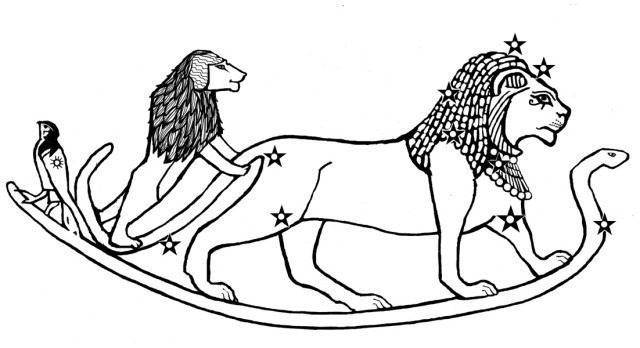
The ancient Egyptian goddess Sekhemut is the first facet of feminine signs. Sekhemut is the Lion goddess known as the eye of Ra. She is the daughter of Ra and identified by the Wadjet. The Eye is the part of the divine Feminine that is both protective and destructive. The mirror image of the healing eye is still found in the pharmacy ℞ symbol belonging to Horus.The story of Sekhemut begins when Ra sends his daughter out to bring light to the darkness. She went so far into the darkness and was gone for so long that by the time Shu and Tefnut found her and brought her back Ra had grown back another eye. This enraged Sekhemut, who felt usurped and easily replaced, and her rage built until she shape shifts into a cobra spitting fire. She would strike at anyone, and her rage and blood lust frightened both gods and men until finally Thoth in his wisdom came
up with a trick to sedate her. He concocted a mixture of beer colored with red ochre and poured it out for her to find. Thinking it was blood she lapped up the sanguine liquid and soon fell fast asleep. When she woke from her slumber she had transformed into the gentle and beautiful goddess Hathor. .
In another version of the story, Ra snapped up her Wadjet/cobra form and placed her on his forehead where she became Ra’s inner sight, the source of the symbolism behind the cobra on the headdresses of pharaoh, but it also brings the wearer inner wisdom. Sekhemut, whose name is derived from Sekhem (power)+Mut (Mother and death), is symbolic of the deadly heat of the desert Sun. She is akin to the other feline goddesses Mut, Tefnut, and Bast. The blood associated with Sekhemut is the blood mysteries of menstruation and she is part of the many facets of the Divine Feminine. Her alter ego is Hathor, the gestating lactating cow goddess. Sekhemut is consort of the creator god Ptah and the mother of Khepri Nefertem. The cult center of Sekhemut and Mut is in Luxor (ancient Thebes) and in the late Ptolemaic period Sekhemut was venerated in the form of a cat at Bubastis. Cats are one of the last animals to be domesticated, serving as protectors of the grain. Because of their divine status, killing a cat was a capital offense. Temple cats were adored with jewelry and wore necklaces, earrings, and gold rings on their tails. Cats still live at the various temples throughout Egypt and traces of the Bast cult have been found in Rome, Ostia, Nemi and Pompeii. Even ‘domesticated’ cats remind us that they carry the strong reflexes and reactions of their primal nature and command respect from those who cross their paths.
The Timeline and Human Historical Context for the Age of Leo
Using the Real Sky Astrology™ calculations, around 11,229 BCE Descendants of the survivors of the Ice Age and “the Great Flood” evolved from an era of cataclysm and because of that little is known about their shared beliefs, values, traditions, social norms, and behaviors before the Age of Leo. These people were, as far as we know, hunter-gathers. They used fire and stone tools and. they paved the way for an explosion of technology and cultural change. Much of our remotest human past is still uncharted and though there was time for Pre-Leo empires to rise and fall and be buried, there is no concrete evidence for “lost civilizations”. But that doesn’t mean they didn’t exist. To find evidence of such lost empires we need to search now submerged ancient coasts under the sands of the Sahara Desert and beneath the overgrowth in South America.
Human history before the Age of Leo lacks hard data but it might be argued that the planet’s overall climate between the Age of Capricorn (22,281 BCE) and the Age of Virgo (11,229 BCE) was stable enough to give our ancestors in lower latitudes a strong foothold. In a time when the external world and the internal world were the same, the adage of “As Above, So Below” applies. The Ancient Star Religions gave the Netjeru (deified Nature) personality and chronology, so it is probably not a coincidence that the Age of Leo began as natural conditions became unstable and more “lion-like”. The Age of Leo is an era of big changes - abrupt climate shifts and rapidly melting glaciers left its mark in mythic memory. Epic flood stories exist in many different cultures. The auspicious date of Zep Tepi or “First Time” (10,450 BCE) occurs during the Age of Leo as does the Younger Dryas period when we see huge culture shifts including the domestication of animals and the cultivation of wild
grains. This suggests an abrupt departure from known territory to new lands and the people brought the plants and animals that were essential and sacred to them to start a new life somewhere else. There is also a need to band together as a community to process their experiences, create monuments, commemorate what happened and to create magic to ensure catastrophic events didn’t happen again.
August 10- September 9. The moon is full in this sign between February 16- March 10.
Virgo-Hathor
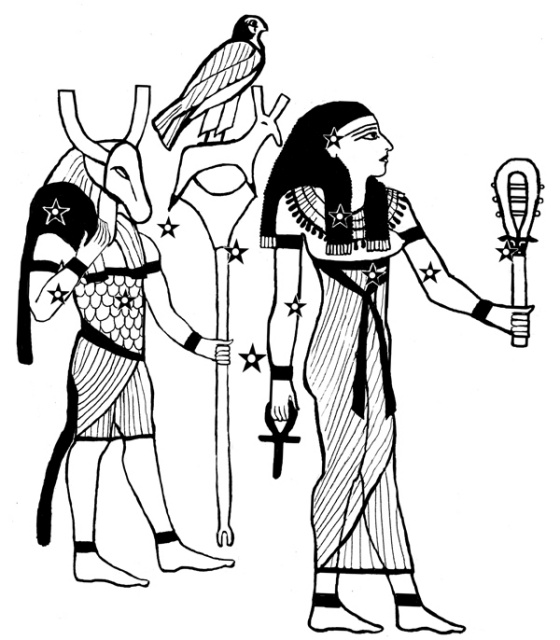
Hathor/Virgo
The Primordial Mother
The ancient Egyptian goddess Hathor goes by many names- ‘The One in the Barque of a Million years’, ‘The Distant Goddess’ (a name she shares with Sekhemut and Bastet), ‘Hathor of the Sycamore’, ‘Lady of the Sycamore’, ‘Mistress of the Desert’, ‘Mistress of Heaven’ ‘Lady of the Western Mountain’, ‘Lady of Turquoise and Faience (tjemenet)’, and ‘Lady of Byblos’. In the temple of Hathor in Dendera the symbolic glyph for Virgo is a woman holding a sistrum and wheat. The sistrum is a tool sacred to Hathor. It is used for celebration, but it is also used to move blocked energy. Hathor, known as a goddess of attraction, is associated with love, fertility, sexuality, music, dance, and alcohol. She is the second facet of the Divine Feminine in the succession of female signs in this system. She is a cow goddess and the alter ego of Sekhemut. She is sometimes depicted as a woman with a cow’s head, a woman with cow’s ears, and sometimes a cow with the Sun Disk between her horns. Hathor is also the Sky Goddess in the form of a star-spangled cow whose legs are the four pillars of the heavens and cardinal points. Hathor, whose name also means ‘House of Horus’, is sometimes known as the wife of Horus so when she is blended with Isis as his mother it refers to lineage. Her affiliation as the House of Horus also refers to the sacredness of the uterus in general. The uterus will grow to the size and shape of a cow’s head at full term pregnancy which is implied in the tombs in ancient Catalhuyük in Turkey. Hathor and Horus’ have a son Ihy who is known as the god of music and the sistrum. Ihy likely the golden calf god of the biblical story. This “golden idol” was rejected by Moses and the reason may have been because the Bull constellation was no longer visible during the vernal celebration of Sham El Nessim. Hathor, as the alter-ego of Sekhemut, is also associated with the eye of Ra, the opposite configuration the eye of Horus for whose sight she is credited for restoring. Her other attributes and symbols are mirrors, mirror magic, and the wearing of cosmetics. The mirror effect includes the idea of the sky reflecting what is happening on Earth and this alludes to her connection to the study of stars. Hathor’s cult center is Dendera, a temple of solidly embellished astrological symbolism. This epic historic temple was destroyed by invading armies from the Middle East and rebuilt from ancient scrolls and records by the late dynasties of Ptolemy and completed by the Romans.The Seven Hathors (Pleiades) played a role in the Egyptian afterlife. Overseeing the trials of the deceased souls she provided milk and food served under her sacred sycamore tree from her seven cows. The antiquity of the goddess Hathor cannot be ignored, and she may be
the origin of the Wadjet, the snake goddess, as her elongated goddess imagery is reminiscent of the arching Nut (Night) over the inert Geb. The origins of cow veneration began in the deepest and oldest parts of Africa- from Nabta Playa’s stone alignments to Sirius and Orion to the ancient cows etched into the rocks in Qurta date to 17,000 to 19,000 years ago. The cow goddess we know today as Hathor may be one of the oldest deities in memory.
The Timeline and Human Historical Context for the Age of Virgo
The Ages end and begin with the subtle nuance of shades of paint or rainbows of light as they blend from one color to the next. Using Real Sky Astrology™ calculations around 14,397 BCE. For centuries the textual evidence of our matriarchal past was passed down via oral tradition and later recorded. This age is the heyday of the Divine Feminine occurring just after the peak of the Ice Age.
These hearty people were, as far as we know, hunter-gathers. They used fire and stone tools, and they paved the way for an explosion of technology and cultural change. Much of our remotest human past is still uncharted and though there was time for empires to rise and fall and be buried, there is no concrete evidence for “lost civilizations”. But that doesn’t mean they didn’t exist. To find evidence of such lost empires we need to search, now submerged ancient coasts, under the sands of the Sahara Desert, and beneath the overgrowth in South
America. The expanse of time between the Age of Capricorn and the Age of Virgo lacks hard data so looking back into time almost becomes an act of divination. The ancient star religion that gave the Netjeru (deified Nature) personality and chronology and the Age of Virgo occurs during a time of Nun, the primordial waters of night before the first mythical sunrise of Atum-Re that is a metaphor for the awakening mindfulness of humans. The Long Age of Neith was a time when life expectancy was around 20 years when focus and power belonged to the Divine Feminine, as hearth keeper, life giver, lover, and magician.
Virgo is a very long sign lasting from September 10- October 30 whether this distortion of size in the signs was by created by renaissance astronomers or if the design signs was more even in the ancient past is unknown to me. The imagery here from the Ptolemy Era ceiling at Dendera is Hathor/Isis as priestess with her sistrum and Set as priest who dismembers his brother Osiris in the shamanic rite of kings. The priest dismembers and the goddess puts the pieces back together and RE-members. At the Sed/Heb Festival ( the source for the Greek Games and modern Olympic Games), the pharaoh is tested to see if he is worthy of his crown. Sed/Heb may be shorthand that relates to Sed/Set/Seth as the destructive principle and Heb/greek for Ibis(Thoth as the creative principle in this great rite of ancient Egypt. The Priestess/ Hathor divine feminine with her sistrum would shake up the energies of stagnation and blockages. She would give the initiate milk mixed with herbs to bring about visions and facilitate the journey thru the far world.The moon is full in this sign between March 11 - April 17.
Libra- The Scales Ma'at
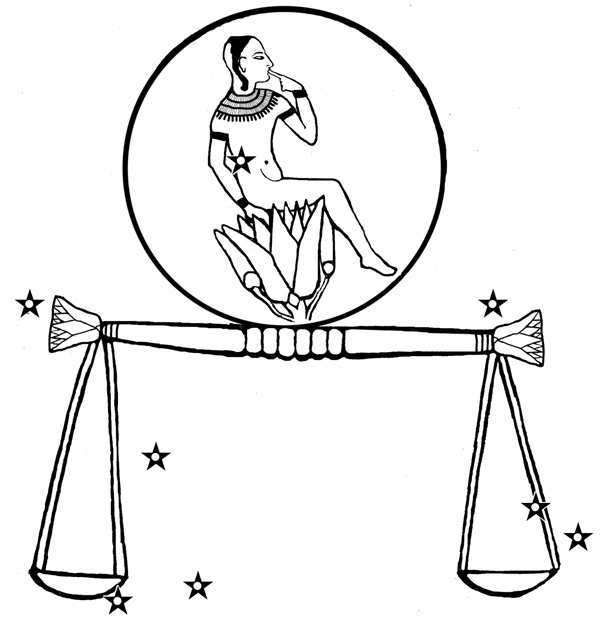
Ma’at/Libra
Universal Law, Nature’s balance.
The ancient Egyptian goddess Ma’at is the 3rd feminine sign in the lineup of the divine feminine symbols. She has always been more of a concept than an actual deity. She is the symbolic representation of the idea of balance in the universe. Ma’at is shown with a feather in her head band and this feather is weighed on the scale in the Hall of Judgment against the heart of the deceased. If the heart is lighter than that feather the soul is allowed to cross into the next world. Before the heart is weighed the deceased is asked 42 questions about the things they did during their life. Here is where the heart could betray the person because the heart knows what is true. If the heart was found to be heavy it would be thrown to Ammit, a beast with the face of a crocodile and a body that was part hippopotamus and lion. If the heart was devoured the soul’s journey ended there. As gruesome as this sounds it is suggested that no heart was ever thrown to Ammit. This entire scene is quite telling about the Egyptian culture; it shows that the seat of Truth is in the heart and not the brain or stomach. The heart was the only organ that was kept with the body in the sarcophagus. In ancient Egypt’s view of the Afterlife, it is not the soul that is at risk of being stolen, it is the heart. When the soul reaches the Duat, it is tested, and Otherworld beings will try to steal the heart. A ‘heavy heart’, or ‘losing your heart’, phrases still commonly used in conversation today, could ruin the Egyptian Afterlife.
In the Hall of Judgment, in front of the throne of Osiris, there is a scale where the heart is weighed against Ma’at’s feather. At the fulcrum of the scale is a small statue of Ma’at where she sits at the point of balance. Thoth records the answers to the 42 questions posed by 42 witnesses, each representing the 42 laws of Ma’at. Osiris is seated in front of the scale with sisters Isis and Nephthys at his left and right. Anubis presents the deceased to his father Osiris. The Scales are the central feature of the scene and a reminder to keep your heart as light as a feather.
Ma’at means balance, justice, and order. She is the law of the universe. Ma’at is an aspect of the Divine Feminine found in the southern stars of reincarnation. Ma’at came into being when Atum-Ra rose out of Nun, and she is referred to as the daughter of Ra. Like Sekhemut and Hathor, Ma’at is referred to as ‘the eye of Ra’. She is typically vulture-winged, carrying her feather in one hand and an ankh in the other.
Ma’at was revered by those in power, and they carried amulets of Ma’at on their person to ensure that she was with them and would bless them. The pharaohs of ancient Egypt were charged with keeping Ma’at; it was pharaoh’s responsibly to ensure the laws of Ma’at were upheld and that the powers of chaos, storms, and destruction were kept at bay. If harmony with nature was disrupted the people could turn against the pharaoh. Together with Thoth, Ma’at’s husband, brother and equal, pharaoh kept the power of Set, god of storms, chaos, and decay in check.
The Timeline and Human Historical Context for the Age of Libra
The Age of Libra begins16,053 BCE, the era of balance and universal law. These hearty people were, as far as we know, hunter-gatherers. They used fire and stone tools. Much of our remotest human past is still uncharted and though there was time for empires to rise and fall and be buried, there is no concrete evidence for “lost civilizations”. But that doesn’t mean they didn’t exist. To find evidence of such lost empires we need to search now submerged ancient coasts, under the sands of the Sahara Desert, and beneath the overgrowth in South America. The expanse of time between the Age of Capricorn and the Age of Virgo lacks hard data so looking back into time almost becomes an act of divination. The ancient star religion gave the Netjeru (deified Nature) personality and chronology, and the Age of Libra occurs during a time of Nun, the primordial waters of night before the first mythical sunrise of Atum-Re that is a metaphor for the awakening mindfulness of humans. The Long Age of Neith was a time when life expectancy was around 20 years when focus and power belongs to the Divine Feminine as hearth keeper, life giver, lover, and magician.The Sun travels thru Libra October 31- November 22. The moon is full in this sign between April 18-May 16.
Scorpio- Selkit and the 13th sign/Imhotep(Serpent Bearer)
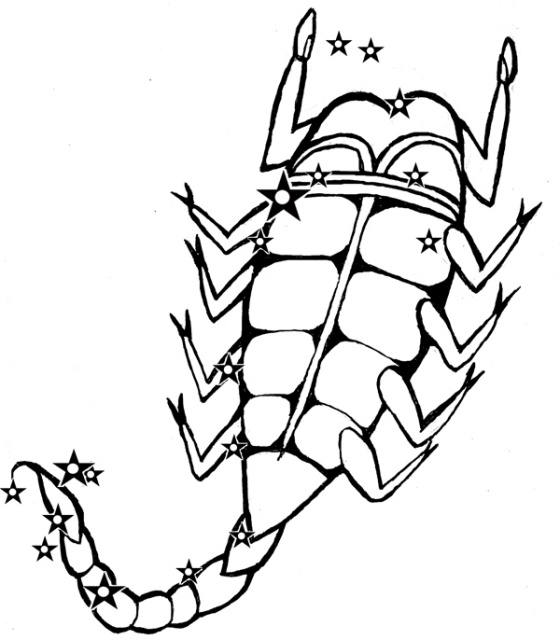
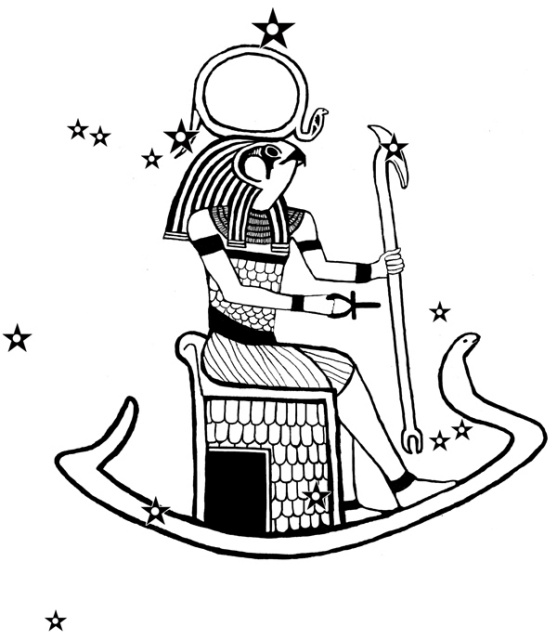
Egyptian God Mythology and Symbolism
We can hardly understand the symbolism behind the zodiac without first diving into the ancient Neters that the star glyphs are based on. The culture that birthed a star religion comes from humanity’s remote past in Africa. The ancient African culture of Khemet has left an imprint on every culture that encountered it and every culture that would try to conquer it would instead be conquered by its wisdom, its medicine, and its symbols. We can still see Egypt’s influence on ancient Greece, ancient Rome, the Roman Catholic Church, and well into our modern world. Egypt (Khemet) itself was influenced by an even older time and this time is reflected in the symbolism of its goddesses. These Neters are still relevant, and their symbolism can speak to us today.
Selkit/Scorpio
The Goddess who heals has the poison.
The 4th feminine sign is the Scorpion goddess of magic Selkit (Serqet, Serket, Selqet, Selket, Selkis). Her name translates to ‘She Who Lets Throats Breathe’, and as guardian of the embalming tent ‘Mistress of the Beautiful House”. Selkit is a protector goddess who is known to go after transgressors. Selkit is illustrated as a woman with a scorpion on her head as well as a scorpion with the head of a woman. Like Hathor, Selkit is sometimes shown wearing cow horns and the solar disk solidifying her place as a facet of the Wadjet/Divine Feminine. Another guise of Selkit is a lion-headed woman with a crocodile at the back of her neck alluding to her connection to Sobek and priesthoods of intense initiations that taught worthy pledges, medicine. According to The Pyramid Texts she is the mother of Nehebkau, a snake god who protects the Pharaoh from snakebites.
The scorpion itself is a member of the arachnid family giving it all the rich symbolism of spider (women) found in other mythologies. The healing properties of scorpion venom is still a powerful medicine against many diseases and conditions from rheumatoid arthritis to cancer. Selkit could kill but she also brings breath to the dead in the Afterlife. In the Underworld, she helps in the rebirth of the newly deceased and orients them as they come to her, giving them the Breath of Life. Her priesthood held the knowledge of poisons and antidotes and this is the biggest clue to the meaning of Scorpio. Originally her cult center was in the Delta, but she spread throughout the land of Egypt, with her presence at Djeba and Per-Serqet (House of Selkit). The priests of Selkit were doctors and magicians at a time when medicine was a mixture of folklore, magic, and science. The Goddess herself was invoked by the people to both prevent and heal poisonous animal bites. Although she had a priesthood, there have been no temples to this goddess found yet. Scorpio takes up the smallest space on the ecliptic sharing space with the 13th sign of Snake Bearer.Scorpio and The Snake Bearer are part of the same month. Scorpio only lasts from November 23- November 29. The moon is full in this sign between May 17-20
November 30- December 17 the sun is in the only sign dedicated to a human being. Imhotep/The Snake Bearer or Ophuicus the only human being represented in the zodiac was the designer of the great pyramid immortalized in the southern stars of reincarnation to insure that he would return again and again to help humanity. He is the one who also brought the design of the pyramids and the wisdom of medicine to Egypt as well. Imhotep is one example of the "personality cults" that formed during the Age of Aries. In these cults, a learned sage or venerated person is deified after death. Imhotep was elevated to a god, replacing Nefertum in the great triad at Memphis. He was also associated with Thoth, the god of wisdom, writing and learning. He was worshiped in Greece, where he was identified with Aesclepius. Early Christians associated Imhotep as one with Christ. Hotep is the word for peace. Imhotep was associated with Aesclepius by the Greeks and with Joseph(pharoah's dreamer with the coat of many colors) by the Hebrews. The sign also called Ophiuchus, a medicine man taught by Chiron, the wounded healer. Serpentarius reminds us that illness is often followed by recovery. The Egyptian image of this sign shows the emphasis on the Snake Bearer as the image is of the god Imhotep being carried on a bearer that is a snake. The image of the goddess Wadjet. Making Imhotep the holy child of the divine feminine.
The Sun travels thru Imhotep November 30-December 17. The moon is full in this sign between May 21- June 20.
The Timeline and Human Historical Context for the Age of Scorpio- Serpent Bearer
Age of Scorpio-Serpent Bearer begins around 17,853 BCE the era of poisons and antidotes. The Actual Age of Scorpio is only the last 500 years of this section of the star lore. People living during this time were, as far as we know all living as gatherers. They used fire and stone tools. Much of our remotest human past is still uncharted, and though there was time for empires to rise and fall and be buried, there is no concrete evidence for “lost civilizations”. But that doesn’t mean they didn’t exist. To find evidence of such lost empires we need to search now submerged ancient coasts under the sands of the Sahara Desert, and beneath the overgrowth in South America. The expanse of time between the Age of Capricorn and the Age of Virgo lacks hard data so looking back into time almost becomes an act of divination. The evidence of what humans knew and cared about in the Age of Scorpio and the Snake Bearer is just being awakened. Amateur archeologist Ben Bacon submitted a study linking the Lascaux Cave paintings with a lunar calendar that tracked the gestational seasons of local animals. Magdalenian Age (21,000 and 12,000 BCE) people created a long, tunneling art gallery during the Age of the Serpent Bearer laying the foundation for what we know as the zodiac today. The images depict markings in the form of dots, dashes and y’s that seem to illustrate the number of lunar cycles it takes for different species of local megafauna to be born. Ben Bacon’s idea that these animal images were connected to star patterns that were visible when each species were mating, the length of gestation, and when offspring were being born. The handprints found in the cave suggest the artists who used sophisticated pigments, oxides and ochres for their paintings may have been females. These ancient women were already tracking their own gestation cycles and births and they turned this wisdom into a study of the other animals in their location.The abundance of art suggests that these people were not living hand-to-mouth, finding plenty of time to observe, create, and experiment. In the Age of Scorpio/ Serpent Bearer the entire visible sky as seen on the equinoxes consisted of feminine signs. The Great Serpent represents the Great Goddess and separating Ophiuchus (The Serpent Bearer) and Scorpio is virtually impossible so modern astronomers and astrologers combine them into one zodiac sign.
By letting our imaginations travel back in time we can imagine these adaptable, observant people experimenting with plants as medicine. We can envision ourselves sitting beside them staring up at the brilliant cosmos watching the Milky Way journey across the sky. We can hear the women elders tell ancient stories about this river of light that divides the sky bringing the souls of the departed back to us.
Sagittarius as Ptolemy Era The Hero/Villain is replaced by The Vulture/Nekhbet 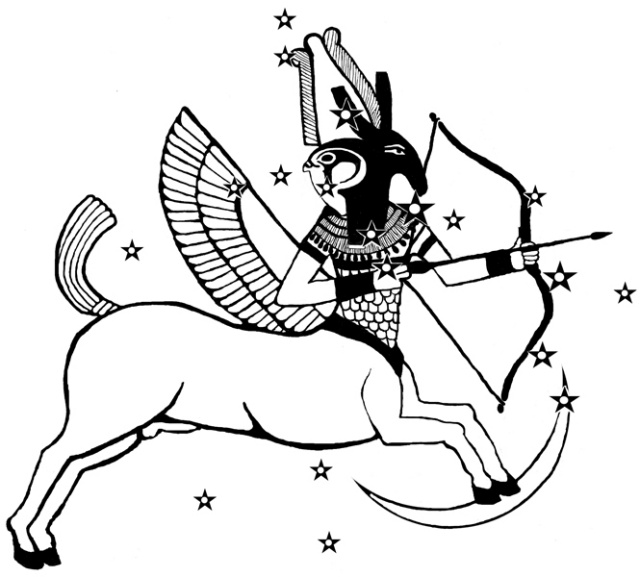
The Ptolemy Era illustrated Sagittarius as a winged horse centaur but with two faces one of Horus and one of Set. Showing the dual nature of pharaoh a hero to his people and a villain to his enemies. This symbol is a potent image full of depth and paradox for the natives born during this month. Balance is paramount in the ancient Egyptian philosophy it is particularly evident in the Egyptian approach to Sagittarius, wearing with heads of the Saviour god Horus and his nemesis uncle Set. Here the god of destruction is one with the god of the morning their arrow takes aim at some distant target. This related to their time period with influences of patriarchal conflict, this symbol is contradictory to the purpose of placing things on the ecliptic that were necessary for life and part of the spell that promised good to return again and again. Looking back at Gobekli Tepe stones a Vulture comes after the Scorpion. The shape of the constellation haunts and the stars look the shape of a vulture.
Mother and Death, I am your protection.The familiar Hellenistic image of a centaur with the bow we all know in the zodiac as Sagittarius is given two faces on the ceiling of Dendera and the horse is given wings like Pegasus. Suggesting that the now popular image as was added later. First, the idea of placing a hero/villain on the ecliptic didn’t seem like something that aligns with the Egyptian ideals of Ma’at and secondly the popular image seems so clearly influenced by the Greeks and Assyrians. Egypt didn’t have horses or chariots until after the Hyksos conquest of lower Egypt in around 1600 BCE. The word sagittārius is Latin and translates to "archer" or “bowman” in English, it’s root sagitta, means arrow. The ancient Greeks associated many constellations with mythical figures, such as Orion the huntsman. Sagittarius is commonly depicted as an archer in the form
of a centaur, a mythical beast said to be half-man and half-horse. The image for Sagittarius so closely resembled the winged Lamassu of Mesopotamia that after long consideration, it seems out of place in the Southern Stars of Reincarnation. The two-faced winged centaur was symbolic of warring and the immortal conflict between Horus and Set, not something that would preserve ma’at, in fact it was more of a reflection of the unrest of the Ptolemaic period that rebuilt Dendera.
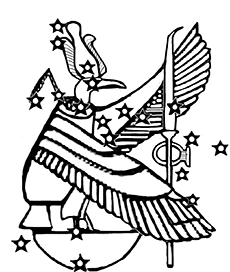
Hints of an older symbol for Sagittarius come from the ancient stones of Gobekli Tepe with its images of a scorpion next to a Vulture. In Animat Oladipo’s ‘The Iyami Oracle’ the Vulture card hints at how old the symbol of vulture is and how vital it may have been to humans in a time of severe climate change. After some research about Nekhbet the Vulture goddess of ancient Egypt the shape of the constellation, particularly the way Patrick Fogarty illustrated Sagittarius in his deck ‘The Living Wheel’, seems to be unmistakably a Vulture. To that end, this system has replaced the modern image of Sagittarius with the more ancient and feminine Nekhbet, the Vulture Goddess, who is often paired with the Wadjet found on pharaonic crowns.
Nekhbet /Sagittarius
The Vulture goddess Nekhbet (Nekhebet, Nechbet) is occasionally depicted as the divine mother or wet-nurse of the pharaoh and often appears in her Vulture form flying above the king holding the circular cartouche-like shen (eternity) and the pharaonic flail. Nekhbet is not just protector of the pharaoh she is protector of all the people of Egypt. Other titles for Nekhbet include ‘Lady of the Great’ and ‘Nekbet, the White, of Nekheb’. And here she starts sounding like the iconic Sagittarius that would eventually take hold. Found on the important Palermo Stone we find this quote by Thutmosis IV who describes her vital role as protector: “Nekbet, the White, of Nekheb. She fastened the adornments of my majesty, her two hands were behind me, she bound the Nine Bows of the enemies of Egypt together for me”. Nekhbet is the wife of the Nile god Hapi. There is a connection with Hathor because Nekhbet is also known as ‘the Great White Cow of Nekb’. She is associated with childbirth
and the goddess Mut (mother and death). Nekhbet’s cultural center Nekheb, Esna at the Temple for Nekhbet-Hathor is in upper Egypt on the west bank of the river between Luxor and Edfu, closer to the heart of Africa. The vulture is venerated and adorns many of the temples in Egypt, it is held sacred by many countries and peoples. The Wadjet and the Vulture are iconic symbols of the union of Upper and Lower Egypt and together they represent a united Egypt. Because she is so important, it makes sense that the vulture would be included in the Southern Stars of Reincarnation to ensure her return. Nekhbet is an important iconic emblem of ancient Egypt, and she may have been excluded from the zodiac by Greek and Roman astrologers, but we have no way of knowing for certain. But experimenting with the symbol and looking at the overall storyline and logic Vulture closes the line of feminine signs and continues on the journey towards the next world.
On the walls of many monuments, you will see the Nekhbet flying above the pharaoh riding in his chariot, furthering her role as protector. More symbolism may also be found within the stories of conflict between Set and Horus. Set is purported to have pulled out Horus’ eye and, in his rage, the blinded Horus pursues Set. Nekhbet becomes Horus’ eye resulting in her association with the eye of Ra and is described as ‘the healthy eye of Horus’, giving Nekhbet the familiar Sagittarius key phrase of ‘I see’. Within the symbolic and important attributes of vulture, she is a visual signal to scavengers looking for easy food. The vulture will not attack; she only consumes the dead, or weak things making her an important link in the life cycle. Vultures are nature’s cleanup crew. For early hunter-gatherers she may haveserved as the one who kept them from starving.
The Sun travels thru Sagittarius between December 18-January 18. The moon will be full in this sign between June 21 - July 19
The Timeline and Human Historical Context for the Age of Sagittarius
The Age of Sagittarius - Nekhbet begin around 20,265 BCE, People living during this time were, as far as we know lived as hunter-gatherers. They used fire and stone tools. Much of our remotest human past is still uncharted and though there was time for empires to rise and fall and be buried, there is no concrete evidence for “lost civilizations”. But that doesn’t mean they didn’t exist. To find evidence of such lost empires we need to search now submerged ancient coasts, under the sands of the Sahara Desert and beneath the overgrowth in South America. The expanse of time between the Age of Capricorn and the Age of Virgo lacks hard data so looking back into time almost becomes an act of divination and we rely on the accuracy of the ancient star religion that give the Netjeru (deified nature) personality and chronology. The Age of the Vulture is during a time Nun, the
primordial waters of night, before the first mythical sunrise of Atum-Re that is a metaphor for the awakening of people. It seems that the Long Age of Neith was a time when power belonged to the divine feminine, hearth keeper, life giver, lover, and magician.
Capricorn The Goat/Fish Khnum and Ra
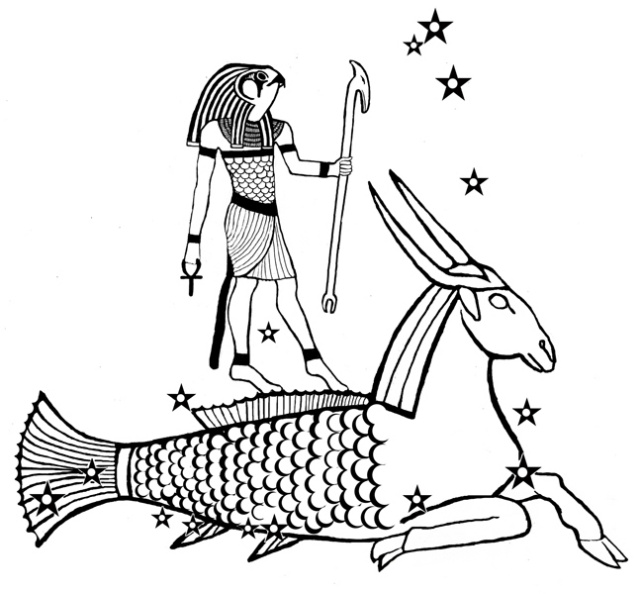
Khnum/Capricorn
I am your guide through the uncharted wilderness, I am the Moon
The god Khnum (Khenmew, Khnemu, Khenmu, Chnum), one of the most ancient pre-dynastic gods of Egypt, merges with the cult of Ra (or Re) during the ‘Pyramid Age’ also known as the Old Kingdom (2649 –2100 BCE). Khnum's cult center is on the island of Elephantine. He was originally considered a god who ruled over water, including in the Duat. He is associated with the source of the Nile, the inundation, and the consequent deposit of fertile silt. This silt is the source of clay used to make pottery. Khnum is closely associated with the art of pottery, creating everything on his potter's wheel including people and other gods. He was also the one who gave health to the child after it was born. Khnum is responsible for making the body and the ‘ka’ (spirit) of each newborn child. The ‘ka’ glyph is represented by two upright arms, like a hug, symbolic of the connection we all have to every other living thing. Khnum's other role as the Protector of the Dead can be seen in his association with the time of new moon, when the moon disappears as it conjuncts with the sun. Khnum is one of the gods who helped Ra and Osiris on their journeys through the Duat or Far World. The Duat is symbolized by the body of the sky goddess Nut. It also represents an internal journey. The Sun God is swallowed by Nut in the west, and he journeys through her body at night and is reborn in the east. Khnum's close association with water includes the celestial waters of the Milky Way. The Milky Way reflects the terrestrial Nile. This illustrates the classic "As above, so below" philosophy. Khnum created the boat that carries Ra on his journey through the Duat. Khnum defends the Sun God against the serpent Apep (Apothis). The ram or goat associated with Khnum is a corkscrew horned Ovis found in Southern Egypt it is a species of caprine native to North Africa and the first breed to be domesticated in ancient Egypt. These horns may symbolize water. Khnum’s wavy horns were considered a symbol of the Nile River.
Khnum-Ra is associated with Nun, the primeval waters (Hap-ur, ‘Great Nile’, ‘Nile of Heaven’), and points directly to his connection to the Milky Way and the Duat. Besides referring to a soul, the word ‘ba’ can also mean ‘ram’. There is a beloved Egyptian pun in which Khnum is sometimes considered the ‘ba’ of the ram-headed Ra. The ‘ba’ is the part of the soul that is with us from one incarnation to the next. The ‘ba’ resides in the ‘ab’ (heart). There is more word play here, too, as the two words are a palindrome. The ‘ab’ is the place where wisdom is stored, and the heart is the only organ left in the body after death. This is like the concept of the soul that stays with a person from one incarnation to the next. That idea still lingers in our modern language as we “listen to our hearts" to find true wisdom. Spells invoking Khnum's help are found in the Book of the Dead. He protects the dead and helps them on their journey through the Duat so that no Otherworld being can trick them into giving away their heart.The Nile River god Khnum has the head of a goat usually with wavy horns that symbolize the waters of the Nile river. Khnum was the one who guided the Sun god Ra thru the perilous nocturnal land known as the Duat. The Sun travels thru Capricorn January 18- February 18. The moon will be full in this sign between July 21 - August 9.
The Timeline and Human Historical Context for the Age of Capricorn
The Ages end and begin with the subtle nuance of shades of paint or rainbows of light as they blend from one color to the next. When did the Age of Capricorn begin to glimmer into reality? According to my calculations around 22,281 BCE but who was around to know they were in the era of uncharted territory, a few million souls who were living through an Ice Age. These people were as far as we know all living as hunter gathers, they had fire, stone tools, and a healthier gut biome that people in our modern world. The research into our remotest human past is still uncharted, there was plenty of time for empires to rise and fall and be buried in the sediment but so far there is no concrete evidence for a lost civilization. The places to explore for evidence of such lost empires would be, all the ancient coastal regions globally that are now below sea level, submerged landmasses under the North Sea, the Sahara Desert, and the overgrowth in South America, if it’s there we will find it. The long era between the Age of Capricorn and the Age of Virgo lacks hard data so far looking back into time becomes an act of divination, relying on the accuracy of the ancient star religion that give the Netjeru personality and chronology. The Age of Capricorn is during a time Nun the primordial waters of night before the first mythical sunrise of Atum-Re that is a metaphor for the awakening of people. It seems that the Long Age of Neith was a time when life expectancy was around 20 years focus and power belongs to the divine feminine, hearth keeper, life giver, lover and magician.
Aquarius- The Water Bearer
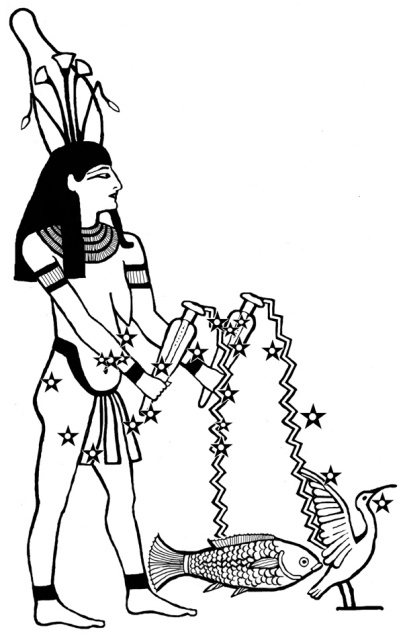
Hapi/Aquarius- The Water Bearer
Water is Life, timing is everything.
The God Hapi or Hapy (from the word ‘hep’; the original name of the Nile) is a blue skinned androgynous god with pendulous breasts wearing lotus flowers in his hair. Hapi is known as ‘Lord of the Fishes and Birds of the Marshes’ an obvious god of fertility. He is depicted pouring water from two jugs. The water has a distinctive zigzag pattern that symbolizes the river as well as the primordial waters of Nun. Hapi is the personification of the Nile River. The Egyptians are masters of living in harmony with nature and know that without the Nile River Egypt would be a lifeless desert and they treat this resource with great respect. The annual flooding of the Nile River was as predictable as the rising of Sirius. The people depend on this annual flood and harness its power to make their lives better. During the season of the Inundation (Ahket) Egyptians used the floodwater to transport heavy stones from the south to the north. The water became the ‘bearer’ of the colossal stones that built the monuments of ancient Egypt. Their religion was nature-based, and their gods were the forces of nature (neters/gods). Predicting the annual flood using the rising of Sirius is so precise that it is a cornerstone of the Egyptian calendar. The Inundation marks the new year when the blue-green Nile swells and turns red as it picks up its annual load of silt from central Africa. This floodwater revitalized Egypt and created a 4-mile-wide swath of fertile ground out of the desert sand. This annual flood led to a thriving community that lasted well over 4000 years. The Egyptians observed a rhythm of life during each of their three seasons: Ahket, Peret, and Shemu. Ahket is the Season of Inundation occurring between July and late September. The predictable and timely Nile flood is both life-giving and destructive. Sometimes possessions are washed away and lost, while at the same time silt gifted by the Nile each year provided Egyptian fields with fertile soil. During the season of Ahket scientist/priests would measure the flood water which helped them prepare for an abundant or meager harvest and plan accordingly. The disappearance of Sirius and Orion, which lasted 70 days, signaled the coming of the flood. The Nile's color change signaled the dismemberment of Osiris by Set and the RE-membering by Isis. After being re-membered, Osiris would become the God of the Dead and monuments would be built while the people waited for the flood water to recede. The season lasted until the flood subsided and fields could be planted again.
Peret is the Season of Emergence. The flood waters have subsided and the season of planting and growing began. The Egyptian growing season lasted from October until February. The planting would begin after the Autumnal Equinox in Egypt because the sun is less intense. Peret marks the second New Year as seeds germinate and plants emerge from the ground. The soul of Osiris is seen in all the new growth.
The third season of Egypt is Shemu, the Season of Harvest. It is also known as The Deficiency. During Shemu, falling roughly between February and July, the harvested fields and increasing heat begins to turn the land into parched desert.
There’s a common denominator in the word ‘Hep’ that links Hapi, Ptah and Osiris to the fertile river and the seasons. Hapi represents the Inundation; Ptah represents the building that occurred during the Inundation; and Osiris with the Emergence and his resurrection. There is a coherent connection of beneficial Egyptian gods within the symbolism of masculine zodiac signs Capricorn, Aquarius, Pisces, Aries, and Taurus. The Stars of the South were consistently the stars that would disappear and return symbolizing reincarnation and ensuring the Egyptian magical practice of placing what they wanted to return on the ecliptic brought them future prosperity. The promise of the Sun’s return each morning and the waxing and waning moon cycle shows that the Egyptians saw consciousness in the universe, in the natural world around them and this fostered their understanding of Life Eternal.
The Sun travels thru Aquarius February 19-March 9. The moon is full in this sign between August 10-September 15.
The Timeline and Human Historical Context for the Age of Aquarius
When did the Aquarian Age begin to glimmer into our reality? I can’t give you the exact moment, but the hints may have started during America’s Revolutionary War when a fraternity of men stood up to the Divine Rights of Kings. This may never have happened without the oppressed people of Europe’s exposure to the indigenous nations, the people who were living free. The commingling of cultures injects each culture with new ideas and growing pains. The mechanical inventions of the 19th century were another step to the beginning of the Aquarian Age. The inventions of Nikola Tesla, held back by the obstructionist robber barons who represent the tricksters of the age of Pisces chose to use these new inventions to make themselves wealthier and more powerful like the symbolism of nets used by Fisherman. By the introduction of the computer and the internet the age of high-speed communication is bringing us more and more clearly into the age when we can’t just believe but we must know. The contrast between the Age of Pisces and the Age of Aquarius is becoming more pronounced.
Our modern astronomy apps that show the stars above and below the horizon will tell you that we still have 300 years before we are in the actual Age of Aquarius because at dawn on the Spring Equinox, Pisces is still on the horizon. But by the standards of the ancient Egyptian Sky-Watchers we are already in the Age of Aquarius and here is why. The age has always been signified by the gaze of the Sphinx who sits watching the eastern horizon at the place that is the portal of the sun on the eastern horizon on Vernal Equinox, observed an hour before dawn the constellation that rises is the god of the Age it is the sign that occupies the 12th house. The 12th House represents our relationship with the divine/ the universe/ our spirituality. And in this spot now the resident constellation is not Pisces but Aquarius. With the Sun in Pisces at Equinox the constellation is obscured by the light of the sun and no longer visible. The Western Tropical Astrology is a fixed system that keeps us in the Age of Pisces permanently, confusing the fixed houses of the horoscope with the idea that the constellations are fixed in heaven and that they somehow relate to the seasons. That is not the case, and this argument falls apart the minute that you see that the Southern Hemisphere is not taken into consideration. The point is this the sky moves back one degree every 72 years and over time a different constellation or sign will be visible at the spring Equinox in the Northern Hemisphere, to believe anything else is just the projection of magicians and tricksters who have enjoyed power during the Age of Pisces. What we need to understand is that the study of stars is something that is moving and changing, that the Houses and their meanings are fixed, but the constellations are slowly moving. Tropical astrology is spot on when it comes to the timing of retrogrades, what houses the planets are in but the zodiac signs from an antiquated stagnant sky keep the symbolism from truly being realized. The sign of the times is Aquarius the symbolism can be found in the Star card of the Tarot, the Star card represents timing, specifically the timing of the annual flood in ancient Egypt. The star is the brightest star in the night’s sky with a 365-day orbit it kept time better than any other mechanism, it was used to navigate vast ancient landscapes.
No small coincidence in the Age of Timing and synchronicity... The last time we had the Age of Aquarius 26,000 years ago humanity had its first outbreak of a coronavirus.
Pisces- Thoth (magician and scribe of the gods) as gatekeeper of the Duat
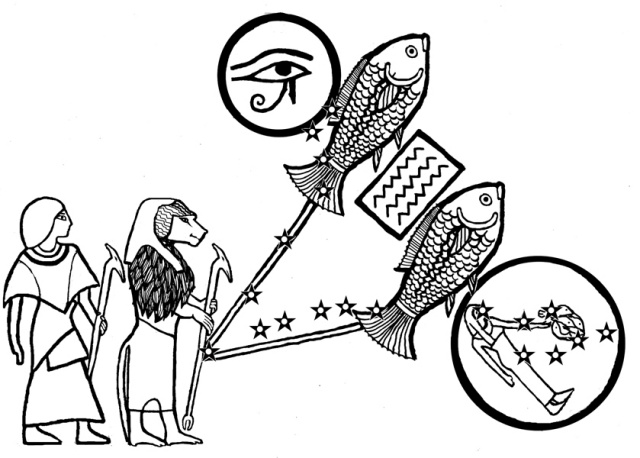
The sign of Pisces as it looks in the ceiling relief at Denderah is a figure holding a staff connected to two fish, the fish were separated by a box and on either side of the two fish there were two circles with symbols. The figure’s face looked like a lion to me at first and then I realized it was a baboon. I realized what I was seeing was an illustration of the story of the first test in the afterlife. In ancient Egypt the baboons (sacred form of Thoth) would come out at sunrise and sunset to fish and because the sunset and sunrise were thought to be the portal to the far world or the Duat they saw the baboon as the first guardian or gatekeeper to the after world. The figure standing behind the baboon has a human face. Now the story goes that if you were not spiritual you would be caught in the nets of the “fisherman” as the fish was the hieroglyph for the physical body that would rot. So if you were just a body your life in the Duat would end right there caught in the net. But if you could convince the baboon that you too were a fisherman tell him all the sacred words (god’s and goddess names) that described the parts of the net you would be allowed to pass on to the next test. There would be numerous other world beings that would try to steal your heart (the seat of your wisdom) and you would have to trick all of them into thinking you were a god."
Thoth/Pisces
Spells and spelling, the word becomes God
Thoth, (Djhuty, Djehuty, or Tehuty) is one of the earliest Egyptian gods and he is scribe to the gods as well as a magician. He is a lunar god taking the forms of an ibis-headed man, ibis and baboon. The symbolism of the constellation of Pisces found on the Dendera ceiling harkens back to the oldest stories of Thoth and his role as guardian of the portal to the Far World. Here we see an initiate or the newly deceased following Thoth in his baboon form. Thoth and the initiate are directly under the Ram constellation implying that the beginnings of the age of Pisces can be found in the age of Aries. The baboon clearly holds the line on which two fish are attached. Between the two fish is a net. One fish aligns with the eye of Ra while the other aligns with a woman holding a net full of fish. The stories about Thoth in his baboon form from The Egyptian Book of the Dead speak about the apes of dawn who gather at the shore of the river to catch fish. The symbolism is rich with meaning because the place where the sun rises and sets, were the doorway to the Duat (Far World) making Thoth the guardian of this gate. The fish symbolism relates to the part of the body that decays. Fish were thought to be Sethian (impure) creatures and no priest of the temple would ever eat fish. So, the image of the baboons catching fish at the river becomes a parable about Thoth catching impure souls in his net before they could cross into the next world. In the imagery of the Ibis-headed Thoth in the halls of Judgment, he holds a ledger and stylus keeping a record of the deceased whose heart is weighed on a scale against Ma’at’s feather of Truth. Here, too, Thoth is poised to ask the dead questions before they are allowed to enter the next world. By the time we get to the late period Greco-Roman era, Thoth begins to transmute into Hermes Trismegistus (thrice great Hermes) which will be his moniker during the Age of Pisces. Hermetic writings became the authority on all secret occult subjects and were known only to initiates. The almost invisible hand of the god who had been known as Thoth had a great impact on the age of Pisces. From the Renaissance until the late 19th century, Hermetic literature was limited to a small group of academic eccentrics. Hermetic texts were a popular core religious practice during the early Roman Empire. All the deep philosophies and knowledge were recorded in the ancient like Greek and Latin, making the texts only accessible to highly educated individuals of the era.
Thoth had many titles: 'Reckoner of Times and of Seasons', 'God of the Equilibrium’, ‘One who Made Calculations Concerning the Heavens, the Stars, and the Earth', and ‘The One who Measured out the Heavens and Planned the Earth'. He was called, 'He who Reckons the Heavens, the Counter of the Stars, and the Measurer of the Earth’,’ He who Balances', 'Master of the Balance', 'The Lord of the Divine Body', 'Scribe of the Company of the Gods', ‘The Voice of Ra', ‘The Author of Every Work on Every Branch of Knowledge, Both Human and Divine', and ‘He who Understood all that is Hidden Under the Heavenly Vault'. Thoth had two wives Seshat (Goddess of Writing) and Ma’at (‘Central to order both in Egypt and in the Duat').
The Timeline for the Age of Pisces
The Ages end and begin as one constellation slips back and disappears into the morning sun while another becomes visible and prominent on the horizon just before dawn on the Equinox. These observations were part of the religious practices of the sky watching priesthoods of ancient Egypt. Why the Equinox? Well, it is because the temporary perfection of the Equinox is the balance between night and daylight hours. For ancient Egypt ma’at was the basis of culture, religion, and the concept behind universal law and the Equinox reflected the ultimate balance of night and day.
Counting back the 37 degrees and calculating the 72 years per degree for the Piscean Age, brings up the auspicious date in the mythic memory, the founding of Rome. The influence of Rome and the Roman Church that has lasted well into the modern age becomes the backdrop for the symbolism behind the Age of Pisces the god sign of Thoth the magician and scribe of the gods. The dates literally unfold like a tarot reading and the story behind the Age of Pisces-Thoth begins to look like a stylized Egyptian myth, a classic story re-illustrated in the fashion of a different culture and era, with historical figures playing the parts of Isis, Osiris and Horus.
As Egypt reveals itself, we can see that what we have learned from the Greeks about Egypt is just scratching the surface. The priests of Egypt did not share everything they knew with the Greeks and Romans, and these foreign rulers never bothered to learn the language of ancient Khemet, so they were never able to fully grasp all the wisdom coming out of Africa. However, we can be grateful for what was saved for us to learn and hope that more will be uncovered in the years to come, as our knowledge base catches up with the past.
The Age of Pisces is a time of Magicians and Scribes when history was written by the conquerors and the masses tethered to beliefs and used as pawns for the whims of their divine rulers. The Age has been a time when believing has kept us under the protection of the realm and the people had to tolerate the cruelties of life while elites took over the tasks of politics and higher learning. The biggest reason the few had power over the many was due to the belief their power was bestowed to them by something called the “Divine Right of Kings”. To not believe in the king was also to deny “God” and their god was a vengeful god who would deny you an afterlife. This deception allowed priesthoods to be the only bridge between individuals and the consciousness of the universe. This belief also perpetuated the idea that individuals are separate from this consciousness and will be separated from their beloved dead if they are not in compliance with the authority of the theocracy. It was a good gig for the elites while it lasted, but an educated population soon sees holes in the system. The Piscean Age of Believing is giving way to the Age of Knowing as Aquarius becomes the constellation on the horizon at Equinox.The Sun travels thru Pisces between March 10- April 19. The moon is full in this sign between September 16- October 30.
Aries- The Ram/Amen-Ra
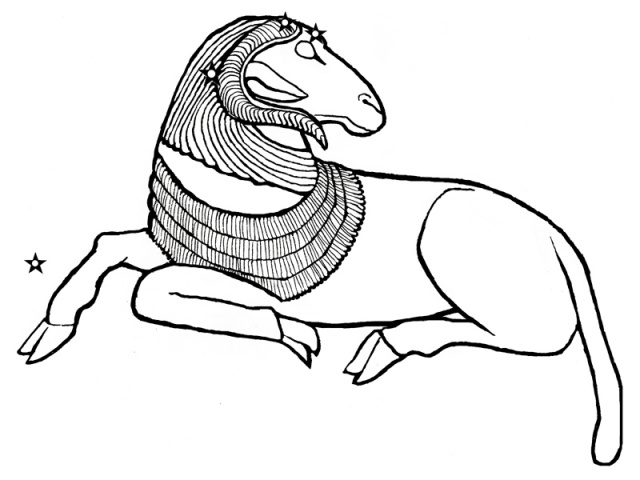
Amen-Ra - Aries
The Invisible Energy of the god is in all of Us
Amen-Ra (Am, Amun, Amon, Amoun, Ammon, and Hammons) is a ram-headed deity known as the god king of Egypt and part of the holy trinity of ancient Thebes (Luxor), particularly at the Temple of Karnak. Amen-Ra, Mut, and their son Khonsu make up the divine family of Thebes during the Age of Aries. In the earliest history of Egypt Amen-Ra is the merging of two gods. Amun, God of the Air, literally means The Hidden One and Ra the Sun. Prior to the Middle Kingdom (2055-1650 BCE), Amun was relatively obscure.
The interesting and telling attributes of Amun are that he created himself and then everything else in the universe, but then distanced himself from his creation and became the source deity for all the original inscrutable and indivisible creator Gods. When Amun and Ra merged, he became both a visible and invisible deity. The ancient Egyptians understood the invisible powers of the universe and this is also understood through the universal laws of the goddess Ma’at who represents balance in the universe.
It was during the New Kingdom period 1550-1100 (I have 1069 BCE) BCE that Amun became the most important deity in the Egyptian pantheon and to mark his new prominence, his invisible? identity Amun merged with the visible sun god Re of Heliopolis in the north. The composite god Amen-Ra then became ‘King of the Gods’, ‘Lord of Heaven’, and ‘Lord of the Thrones of the Two Lands’.
The ram-headed god of Karnak Amen-Ra also appears in humanlike forms wearing the typical knee length kilt, vest with shoulder straps, and a helmet with two large feathers on top with a long red ribbon hanging off the back. His skin is usually blue or black, but sometimes it was red. He holds a staff in one hand and an ankh in the other. Amun may also have ties with the fertility god Min, who also wears a tightly wrapped white garment like a mummy. Both Amun and Min personify masculine sexual potency.
The Re or Ra aspect of this deity, the god of the Sun, travels across the sky each day in a burning boat. Amen-Ra's boat travels through the Duat or World of the Dead at night which is often depicted as the long body of the goddess Nut.
Amen-Ra was heralded as ‘the King of the Gods’ and the Greeks equated Amun with Zeus and the Romans equated him with Jupiter in lockstep with whatever the Greeks doing. The association of theses foreign war gods muddies the purpose of placing the Ram god on the ecliptic. The confusion begins when the constellation of the Ram gets associated the name Aries associated with the Roman calendar’s first month of March and the god of war Mars. A war god would not have been something the Egyptians would have wanted in the stars of reincarnation. The power of the ram was in its ability to feed and clothe the people of ancient Egypt. Amen-Ra was placed on the ecliptic to ensure the world would always have wool and meat. The injection of the war god by Greco-Roman culture occurs after the Age of Aries. Amen-Ra is the source of all the other abstract invisible sky father gods like Yahweh and the later Christian Father god.
The god king Amun was usurped during the Amarna Period in the New Kingdom by the new deity Aten when Akhenaten, the heretic pharaoh, broke with the priesthoods of Karnak and built a new capital in Amarna north of Luxor. Worship of the Aten was abandoned after the death of Akhenaten and his replacement Tutankhamen reconciled with the priests of Karnak, reinstating Amun as the main deity.
The Timeline for the Age of Aries
The Ages begin and end with the subtle nuance of shades of paint or rainbows of light as they blend from one color to the next. When did the Age of Aries begin to glimmer into our reality? Somewhere between the end of pyramid building and the mythic founding of Rome lies the Age of Aries. The writings of a man raised in the pharaoh’s house who chastised his followers for worshipping a golden calf seems to give a clue to the changing of the age. The implementation of the worship of the invisible god was introduced by a man who identified himself as Moses. Moses established the worship of the invisible god I Am, another name for Am Ram or Amun. Perhaps Moses knew that the constellation of the Bull was no longer visible on the eastern horizon at Equinox and ittime to move from the worship of the Bull/Cow/Calf and time to serve the invisible Amen-Ra. Maybe this transition was part of reestablishing ma’at after the cataclysmic explosion of Thera that nearly destroyed the Minoan culture in Crete and wrought havoc and destruction in Egypt around 1500 BCE. The biblical stories of the invisible god of Moses that describe a pillar of fire and a burning bush were describing the volcano and its effects. The plagues of Egypt visited on the pharaoh could have been the environmental impact of tsunamis that pushed sea water into the delta and flushed salt into the fresh water of the Nile River.
Evidence in the form of Cretan-styled wall decorations found in ancient Luxor may be evidence of a refugee population that made a new home in Egypt. There are even some people who think the “Amarna” Queen Nefertiti, mother of Tutankhamen, may have been of Cretan descent.April 20-May 13. The moon is full in this sign between October 18- November 16.
Human Historical Context for the Age of Aries
The Age of Amen-Ra is the ram-headed deity god king of Egypt and part of the holy trinity of ancient Thebes (modern day Luxor) particularly at the Temple of Karnak. In Egypt’s earliest history, Amen-Ra was the merging of two gods: Amun ("The Hidden One"), god of the airand Re the sun. Prior to the Middle Kingdom (2055-1650 BCE), Amun was relatively obscure. The interesting and telling attributes of Amun are that he first created himself and then everything else in the universe, but then he distanced himself from his creation and becomes the source deity for all “the original inscrutable and indivisible creator” Gods. When Amun and Ra merged, he became a visible and invisible deity. The ancient Egyptians seemed to have understanding of the invisible powers of the universe as well as the universal laws of the goddess Ma’at who represents balance in the universe. Amun is sometimes depicted as a goose, snake, or ram, frog, royal cobra, crocodile, or ape.
During the New Kingdom period (c 1550-1295 BCE) Amun became the most important deity in the Egyptian pantheon and to mark his new prominence, his identity was merged with the sun god Re of Heliopolis (modern day Cairo) in the north. The composite god Amun-Re then became "King of the Gods," "Lord of Heaven" and "Lord of the Thrones of the Two Lands". Honoring Amun became a central theme in much of Egypt’s grand architecture at this time, as can be seen in temples including Hypostyle Hall and others.
Karnak temple and Hatshepsut’s mortuary Temple align with the Winter Solstice sunrise which is important because this is the moment when the Sun returns from its journey out of darkness. During this period the Sunshines directly on specific story boards, which are carved into stone at themortuary temple. Being in the northern hemisphere, Egypt receives the shortest hours of daylight between November 18 and January 24 yet the Sun’s winter rays still manage to shine on certain magical symbols in Hatshepsut’s mortuary temple adding credibility to her divine conception as a daughter of Amun. To further legitimize her royal pedigree through her mother Queen Ahmose (daughter of pharaoh Amenhotep I), Hatshepsut portrayed herself as a daughter of Amun, a living embodiment of the divine. This was an important pronouncement because her father, Thutmosis I, was born a non-royal but ascended to pharaoh because of his valor in battle and his marriage to Ahmose, who was of royal blood. Though her religion, proper staging, story boards, and the writing on the walls helped Hatshepsut legitimize her rule, the incredible success of her reign is due to her personal abilities as a leader. It is apparent that her pharaonic father Thutmosis I knew she had better leadership skills than her sickly half-brother/husband Thutmosis II.
Amen-Ra is synonymous with the fertility god Min, who wears the tightly wrapped white garment like posthumous Osiris. Both gods personify masculine sexual potency during the late 18th dynasty. This is also when traditional matrilineal descent of the queen’s line ended. With the death of Hatshepsut and her daughter Neferure, patriarchal descent begins. The legacy embodied in the images of the throne on the head of Isis and embodied in the name of the goddess Hathor, House of Horus, also came to an end. By the start of the Amarna Period (c 1352-1327 BCE) the horrific effects of male succession inbreeding begins to appear in the physical anomalies apparent in Pharaoh Akhenaten. During this short-lived period that Amun had a following of priests who were overthrown by Akhenaton (also known as the heretic king) who replaced the worship of Amun with Aton, who is also a Solar deity. This change only lasted during the reign of Akhenaton (1352-1336 BCE) and was reversed during the reign of his son, Tutankhamun (king Tut). The Priesthood of Amun were able to reinstate the god once the heretic king passed away. Egyptologists love to attach the Moses story to Akhenaten because of his one god theory, but biblical Moses’ story is more of a mythical account of when Thera violently erupted and the effects were felt across the world. Accounts of Thera (Santorini) would not have been written into Egypt’s office of mythic memorybecause in doing so this disaster would be doomed to repeat itself. The stories associated with the book of Moses may well be a forbidden, if historically inaccurate, account of the cataclysm.
The pyramids built during the Age of Taurus happened long before the existence of Israelites. The monuments were built by a communal effort during flood season when farming was in hiatus and not by force. The rhetoric of anti-pharaonic sentiment comes from the later Roman period when spin and misinformation was perpetuated by the patriarchy.
Taurus- The Apis Bull
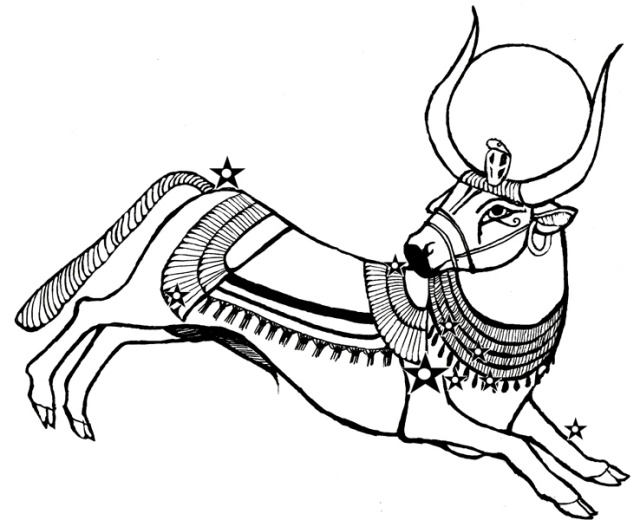
The Apis Bull/Ptah Taurus
Architect of the Universe and the Pyramid Age
The Apis Bull (Ptah, Hap, Hep, Hapi, Phthah, Sokar, Osiris, Serapis, Ta-tenen (risen land), and Tanen (“submergedland”) are all names for the ancient Egyptian bull god of fertility and the Underworld. This deity was worshiped in the Predynastic period of ancient Egypt, perhaps as early as 6000 BCE. During the First Dynasty (3100 to 2686 BCE) Apis grew to become one of the most revered gods in Egypt. Although he began as a fertility god, the bull eventually came to symbolize eternity and the cycle of life and death. The Apis Bull may be connected to the huge bull/cow carving found at Nabta Playa in the Sahara where people aligned standing stones to the positions of the belt of Orion and Sirius during the flood season in an era of global climate change.
The Apis Bull represents the Ba of the creator god Ptah in life and in death the Bull becomes Osiris. Every 25 years a bull with specific markings was identified as the incarnation of the god Ptah and kept at The Temple of Ptah at Saqqara, Egypt. At the end of the 25-year cycle, the Apis Bull was sacrificed and entombed in a grandiose ritual that lasted 70 days. The sacred bull’s death symbolized his union with the Underworld god Osiris, and after which was called Serapis. The prefix ‘apis’ relates to apiary and connect him to the bee. At the death of the Bull bees are attracted to the blood and the buzz from the swarm was heard as the voice of Osiris. We can clearly recognize the origins of the “Opening of the Mouth” ceremony which allowed the dead to speak to the living being associated with Ptah. The symbolism of the beeas a superorganism is also at play here; the people of ancient Egypt acted as a superorganism by working together to build monuments reflecting the universe. The 70-day burial rites reflect the time it takes for constellation Orion and Sirius to disappear into the Sun and return. After 70 days, another bull with the same markings would be sought as the reincarnated Ptah. According to Herodotus, the priests would look for a black bull with a distinctive white diamond shape on his forehead, a vulture on its back, a scarab mark under his tongue, and ‘double hairs’ on its tail.
The craftsman god Ptah in his human form is depicted as a mummified man with his arms unwrapped holding three tools: typically, an ankh staff (life), a djed (stability), and a was scepter symbol of power, domination, authority, wealth and control over the forces of chaos and destruction. Ptah is associated with the primordial mound rising from the water (like the pyramids). Coincidentally or not, the pyramids were built during the time when the constellation of the Bull could be viewed in the east an hour before the sun rose on Spring Equinox. The constellation of Orion (Osiris) and the star Sirius are always just below the ecliptic under Taurus.
Testament of the enduring significance of Ptah is carried on in the fraternal orders of the Freemasons and Knights Templar as influenced by Coptic ideas of God as the ‘great architect’, ‘master architect’, and ‘framer of everything in the universe’.
The Timeline and Human Historical Context for the Age of Taurus
The Ages begin and end with the subtle nuance of shades of paint or rainbows of light as they blend from one color to the next so there is no hard line for when the Age of Taurus began. But counting back the 72 years for each degree, the serendipitous dates of 5181 BCE-2517 BCE will be used for the Age of Taurus.
The Age began during the time when humans first began managing honeybees after eons of collecting honey, wax and propolis in the wild. The Age ends after the pyramids were built or at least after Khafre wrote his name inside one of them.
Though the information presented here may not be part of the historical and scientific dogma explaining Egypt’s past, the Age of Taurus is one that often defies our modern-day view of history and magic. Consider the 40,000+ unexplainable, mathematically precise basalt jars found under the step pyramid at Saqqara when simple tools were made of copper. These buried stone jars were made during Naqada II (aka Gerzean Period) which falls in Egypt’s late Predynastic period between 3500 and 3200 BCE. Although credit for building the step pyramids at Saqqara is given to Imhotep, vizier of Khafre, there are stories about the construction of the Great Pyramids of Giza being attributed to Thoth, magician, scribe of the gods, and guardian of the portal to the Duat. As a matter of note, structures like the pyramids found at Giza and the submerged Osiris Temple at Abydos are conspicuously unadorned with Egyptian writing.
The first rudimentary hieroglyphs are found between c. 3300 and 3100 BCE near the mouth of the Wadi Hammamat on the great eastward bend of the Nile in upper Egypt and represent an embryonic writing system. This region’s local god was Set, and scribe of the gods Thoth is the self-generated son of Set. The dawn of writing happened during the Age of Taurus and the act of scribing can be compared to an act of magic. If shown a drawing or painting of a bull or cow, most would be able to identify it as such. However, if one is shown an arcane symbol that represents a cow or bull only those steeped in that tradition would know its meaning which could seem like magic to the uninitiated. As writing progressed it became a way of keeping track of property as well as important events, especially for the elite.
The invention of paper made from papyrus occurs just after people begin to use the hieroglyphic writing. What is currently the oldest papyrus scroll ever found is a document called the Diary of Merer describing the building of the pyramids and is the main source for Egyptologists who date the completion of the Pyramids of Giza to around 2550 BCE. Written by an ‘inspector’ named Merer it documents him leading a crew of around 200 men traveling Egypt picking up and delivering different products. The 4,500-year-old scroll details the quarrying of limestone from Tura (Ro-Au) and moving it by barge 20 km to the Giza site. Depending on the calendar used, the widespread use of papyrus is well documented until c. 800 CE and the crafting of papyrus is still part of tour souvenirs for modern visitors to Egypt.
During the middle of Age of Taurus around 2750 BCE, the Sothis Calendar was established based on the 365-day cycle of Sirius. It celebrated the new year with the star’s rising which coincided with the annual Nile Flood. Acknowledgment of equinoxes framed the solar year.
With the movement of humanity into concentrated settlements, the building of colossal structures, and more sophisticated systems of interaction there is also a new patriarchal hierarchy. Taurus is the first in a line of ages touting masculine deities. Humans are learning to work together, like bees, to create magnificent architecture and complex societies. The symbolism of the Apis Bull as the physical manifestation of craftsman god Ptah summons an image of oxen as instruments of greater power that may have aided the people who moved the massive stones into place.
Based on calculations of poorly translated texts, dogmatic fundamentalists place their biblical creation story during the Age of Taurus. Their bible stories align with geological and evolutionary happenings, but their dates and conclusions are disproportional and unrealistic.
May 14-June 20. The moon is full in this sign between November 16- December 17
Gemini- The Twins
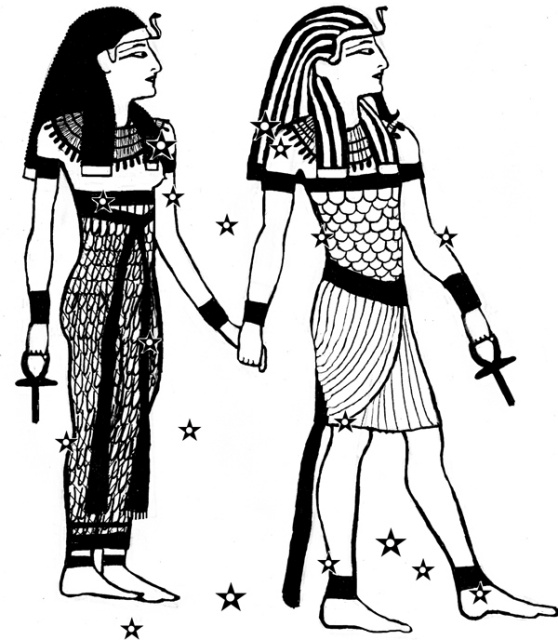
Gemini-the Twins represents the egalitarian nature of the Egyptian gods for all gods had a twin or goddess partner. The modern astrological Twin image is usually depicted as Caster and Pollex, twin brothers born out of the coupling of Zeus and Leda. However, in the ceiling at Denderah, the twins are male and female. In the traditional western astrology the masculine pairing gives support to Roman pairs like Romulus and Remus, the male twins who founded Rome. While this fits the Roman worldview, this image fails to connect with Egyptian symbolism, and particularly the virtue of balance. Fraternal male and female twins illustrate the commonality between the sexes. This is consistent with Egyptian belief systems; the divine beings of Egypt always come in male and female pairs.
Twin Gods of Egypt/Gemini
We are One
The Twins in Real Sky Astrology Egyptian God Signs are represented Isis and Osiris, the two most familiarized siblings in the Egyptian Ennead. However, in ancient Egypt all gods have a masculine and feminine version. In the zodiac wheel from the ceiling of the Hathor Temple at Dendera, Gemini’s twins are male and female, Shu and Tefnut reflecting the egalitarian culture of Africa’s remote past. Male and female twins shift the symbolism from duplicity into androgyny and there is recognition of masculine and feminine within each of us. The idea of twins in the ancient Egyptian gods (also known as Neters) can be seen in the structure of its Ennead creation mythologies. In the beginning there was Nun (primeval waters) and from Nun sprang Atum (Re) the Sun. Atum separates into Shu (air or atmosphere) and Tefnut (humidity) who give birth to male Geb (Earth) and female Nut (Sky). The sibling spouses Osiris and Isis, as well as Nephthys and Set, are born from the union of Geb and Nut on the five epagomenal days, the days outside of time in the Egyptian calendar.
The ancient Egyptian civil calendar was a solar calendar with 365-days. The year consisted of three seasons of 120 days plus five epagomenal days treated as outside of the 360 days. This reflects the high mathematics inherent in the Egyptian culture and is still found in our modern mathematics. The high magic of the Egyptians ties the circle of 360 degrees to the square, as 90 degrees and the opposition at 180 degrees with the calendar, astrology, mathematics and architecture. These measurements are consistently used from the ancient time to the present. This reflects the high mathematics inherent in the Egyptian culture and is still found in our modern mathematics.
The typical association for the Twins of Gemini are Castor and Pollux, brothers and sons of Zeus who rescued their sister and are intertwined with stories of Helen of Troy. Like Romulus and Remus, other male twin stories have mythologies supporting the history and foundations of Ancient Rome and Greece androcentric cultures. In these cultures, might is right and the divine right of kings hold sway. Male Twins from cultures including Egypt’s Set and Osiris, typically default to symbols of good and evil.
Conversely, where symbolism of Twins is male and female, the default becomes creation, equality, and balance between conscious and subconscious, spirit, and matter, above and below, Sun and Moon. Divine couples are often credited with genesis.
Influences from the androcentric civilizations of Greece and Rome have obscured the original egalitarian traditions of Egypt’s male and female twins. TheReal Sky Astrology Egyptian God Signs returns to the original symbolism of male and female twins and recognizes the masculine and feminine within each of us. It highlights the balanced and pronounced masculine and feminine qualities of the natives born during this sun transit. It is an androgynous sign as well as an inclusive one as it sits at the shore of the Milky Way and borders the masculine and feminine signs in this unique Egyptian God Signs system.
The Timeline and Human Historical Context for the Age of Gemini
Why Shu (the atmosphere) and Tefnut (humidity) are so particularly important
The Age of Gemini begins around 7,197 BCE.The people of this era were cultivating wheat, keeping animals, and thriving as populations grew to five million people globally. The descendants of theIce Age survived generations of bitter cold, great floods that drastically changing landscapes and navigated the transition from being nomads to settlers only to adapt to another global transformation– a drastically changing climate. During this time the rising water of the North Sea submerged all but the highest peaks of Doggerland and separated the British Isles from mainland Europe. The refugees of this catastrophe were forced to find new places to live among strangers.
Perhaps the Doggerlanders were met as friends with offerings of bread and beer and given safe harbor. Modern DNA analysis indicates that these Western Hunter Gatherers were darker skinned people with striking blue eyes. Could blue eyes, and their symbolism in Egypt, come from the survivors from the northern regions of submerged Doggerland that found their way into the farthest reaches of the Mediterranean? And if so, did they blend into the fabric of Egypt’s increasingly diverse civilization? The Age of Gemini is a time of union. It is a place in time where like-meets-like. And it’s an age when strangers saw similarities in the other.
Natural History and its Effect on Humans
Approximately 18,000 BCE, around the Last Glacial Maximum (LGM), massive sheets of ice and snow covered 8% of Earth’s land and sea levels were 400’- 600’ lower than today which exposed huge areas of the continental shelf (the edges of continents that lie underwater). Earth’s average global temperatures were about 11°F cooler than today. The global climate during that time was dryer and cooler. After nearly two million years of cyclical advance and retreat of glaciers known as the Pleistocene epoch, the Age of Gemini occurs at the beginning of a warm interglacial period known as the Holocene epoch (9700 BCE -present). It is also at the beginning of the New Stone Age or Neolithic (8000 – 3000 BCE).
Using bones, pollen, sediments, radioactive isotopes, and even human artifacts, scientists can piece together our history, which is intricately intertwined with natural history. There is plenty of evidence that Earth’s climate and ecosystems have shifted over time. As the ice age glaciers melted temperatures rose and landscapes which had been scraped clean by the glaciers began to repopulate with life. Barren land was first colonized by grasses and over time woody plants and trees followed in an ecological process known as succession. As one might expect, changes in temperature and vegetation led to changes in animal populations as they followed their preferred food sources. And humans weren’t far behind.
As can be expected in any transitional period, overlapping consequences of climate change can be tumultuous and complex. One such example is an episode known as the 8.2-kiloyear event which occurred approximately 6200 BCE. As glaciers in the northern hemisphere melted at high rates, fresh water flooded into seawater. Freshwater is less dense than salty ocean water, so it floats on the surface. Not only does this additional volume of water increase sea levels, but it also disrupts ocean currents. Ocean currents are extraordinarily important to climate and this event led to sudden and significant cooling in the northern latitudes. Still, the sea levels continued to slowly rise around the globe.
Things today aren’t always what they seem. Looking at the area between mainland Europe and the eastern coast of Great Britain, you probably wouldn’t guess it had been anything other than an expanse of ocean. On a frigid September night in 1931 fishing trawler Colinda was 25 miles off the Norfolk coast when its net dredged up more than fish. The boat’s skipper, Pilgrim Lockwood, found a large clump of peat which he was intending to throw overboard. As he broke it up, his shovel hit an 8 ½” barbed bone spear point. Lockwood’s discovery set in motion a vast exploration of the area which has exposed a long-lost world. Roughly 12,000 years ago (9976 BCE), as the last major ice age was reaching its end, this area was very different. Instead of the North Sea, the region was a series of gently sloping hills, marshland, heavily wooded valleys, and swampy lagoons and home to large herds of animals such as reindeer who were prey for cave lions, saber-toothed cats, cave hyenas and wolves. It is now called Doggerland – named by archaeologist Bryony Coles in the 1990s after the Dogger Bank which in turn was named after 17th century “Dogger” fishing boats. More artifacts have been discovered and date to about 6976 BCE meaning that Mesolithic people populated Doggerland during the Age of Gemini. Archaeologists and anthropologists say the Doggerlanders were hunter-gatherers who migrated with the seasons, fishing, hunting, and gathered food such as hazelnuts and berries. Unbeknownst to these nomads, water previously locked away in glaciers and ice sheets began to melt and as sea levels rose Doggerland was being quietly and relentlessly submerged. Doggerlanders were slowly flooded out of their seasonal hunting grounds.
Around 6100 BCE a series of catastrophic failures in the seafloor around Norway led to the largest known submarine landslides known as the Storegga Slides. They occurred on Norway’s continental shelf in the Norwegian Sea, sometime between 6225–6170 BCE. The slide caused ‘megatsunamis’ with waves over 140’ travelling at speeds exceeding 70 mph. The effects were catastrophic for shoreline communities and many thousands of lives were lost. The remaining populations migrated to higher ground and some of the displaced may have traveled great distances, perhaps to the Mediterranean.
Not many regions of the world experienced as much change following the Pleistocene as Africa. By 5500 BCE, the so-called Atlantic Period (5500 – 3000 BCE) ushered in warmer temperatures and wetter weather than is seen today but there were dramatic fluctuations and variability of temperatures especially in the northern hemisphere. As the monsoon patterns changed, north Africa, which was savannah, saw increased desertification leading to the formation of the Sahara Desert. The first irrigation systems occurred during the Age of Gemini.It is possible that climatic changes caused nomadic people to migrate towards the Nile River, laying the foundation for the Egyptian civilization.The Sun travels thru Gemini June 21-July 21. The moon is full in this sign between December 18 - January 16
So why use Real Sky?
In April of 2009 while traveling to Egypt with 8 others and author Robert Bauval while he was in the midst of writing his book Black Genesis and filming a documentary about this book. Bauval offered us a private lecture on star alignments and temples, challenging us with precession and the changing zodiac. One by one he showed us the real sky star maps for our birthdays. Every one of us had really been born in the sign previous to the one we thought we had according to Western Astrology. He called me out in particular because I used astrology in my work. At first I defended Western Astrology but then I realized Robert was right. And I also knew the real reason this made me so mad was because now I was going to have to rethink astrology. Later Robert took me aside and told me, "Real Sky works...” Still angry and embarrassed I told him his delivery sucked. But this was my pivotal moment of truth. I also realized that each time I used Western Astrology and the sky from 221AD I felt like I was lying. It still took me 3 months and a dream of 78 paintings downloaded in rapid fire to admit to myself I needed to do another deck. Journey into Egypt Tarot has been an amazing journey of discovery and challenge.
You can use any smart phone astronomy app to do real sky astrology. It is easy and it works.
Real Sky Astrology
Egyptian God Signs
By Julie Cuccia-Watts
Is the second book in her Real Sky Astrology Series. This book is created specifically as a guide for her Real Sky Astrology Egyptian God Signs class, at the 39th annual Women & Spirituality Conference in Rochester, MN. Egyptian God Signs is the quintessential uncovering of what may be a deeper insight into the symbolism inherent in our modern astrology glyphs. Find out what Real Sky Astrology Egyptian Gods say about where the planets were on the day you were born. You may not be the sign you thought you were, you may be someone even better.
Volume I includes Age of Aquarius, Age of Pisces, Age of Aries, Age of Taurus, Age of Gemini, and Age of KhepraReal Sky Astrology Oracle of the Great Year
Volume I Paperback version
Volume II
Volume II includes Age of Leo, Age of Virgo, Age of Libra, Age of Scorpio/Serpent Bearer, Age of Sagittarius/Nekhbet, Age of Capricorn
Volume II Paperback version
The 2nd edition Real Sky Astrology Tarot
The 2nd edition Real Sky Astrology convert your Western Astrology Chart Workbook
Real Sky Astrology Guidebook
Updated Real Sky Astrology Tarot at PrinterStudio in large tarot sized and poker size
 =
=
©2026 JulieCuccia-Watts